The Art of Scoffing: A Guide to Expressing Disbelief with Panache
Welcome, dear readers, to a lighthearted exploration of a time-honored tradition that transcends cultures, languages, and eras: the art of scoffing. Yes, you read that right. Today, we’re diving deep into the world of expressive disdain, that little “pfft” sound you make when someone suggests that pineapple belongs on pizza or when someone claims they’ve seen a cat do algebra.
The Origins of Scoffing: A Historical Perspective
Let’s start with a brief history lesson. The first recorded scoff dates back to ancient times, probably around the moment when a caveman suggested that maybe, just maybe, they should try sleeping outside the cave for a change. The response? A grunted “Ugh,” the prehistoric equivalent of “Yeah, right!”
Fast forward to the present, and we find that scoffing has evolved into a sophisticated communication tool, complete with its own nuances and styles.
The Different Types of Scoffs
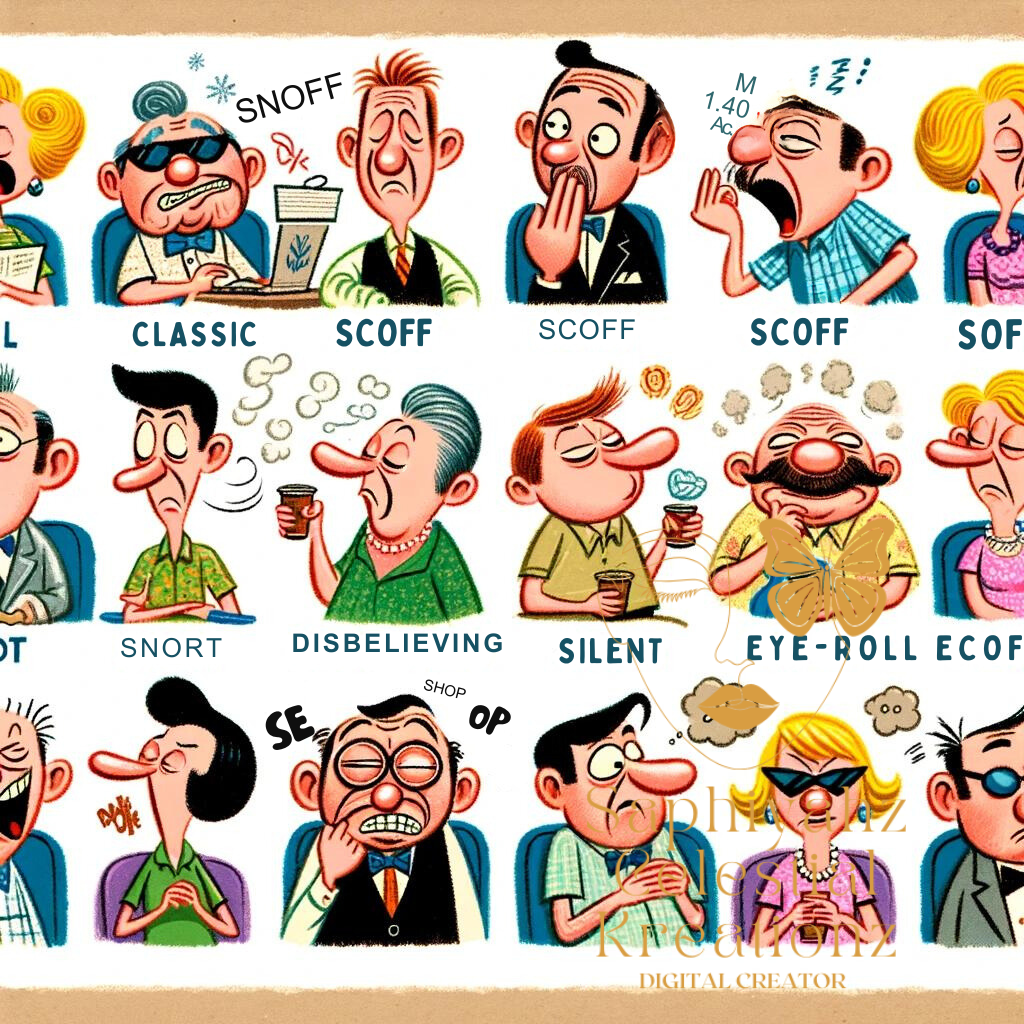
Not all scoffs are created equal. Here are a few of the most popular variants:
The Classic Scoff: This is the scoff you know and love, the one that says, “I can’t believe you just said that,” without needing a single word.
The Disbelieving Snort: A close relative of the classic scoff, but with a nasal twist. It’s perfect for expressing skepticism with a hint of amusement.
The Silent Eye-Roll Scoff: For those situations where noise is not an option, or you’re just too tired to vocalize your disdain.
The Proper Setting for a Scoff
Scoffing is not just about the sound; it’s about timing and context. Here are some ideal scenarios for a well-placed scoff:
At the Movies: When the plot takes an utterly unbelievable turn.
In the Office: Upon hearing the phrase “This will be a quick meeting.”
During Family Gatherings: When someone claims they haven’t taken a piece of the pie, yet there’s whipped cream on their nose.
The Etiquette of Scoffing
Believe it or not, there’s an etiquette to scoffing. The key is knowing when a scoff is appropriate and when it might be better to opt for a more diplomatic response. Remember, the goal is to be witty and engaging, not to start a family feud over the Thanksgiving turkey.
How to Perfect Your Scoff
Like any art form, perfecting your scoff takes practice. Here are a few tips:
Practice in front of a mirror: You want your scoff to convey the right amount of incredulity without crossing into rudeness.
Record yourself: Listening to your scoff can help you fine-tune its expressiveness.
Observe the masters: People-watch in public places (discreetly, of course) to study various scoffing techniques.
In Conclusion
Scoffing is a universal language, understood by all, and an essential tool in the arsenal of human expression. It’s a way to bond over shared skepticism, to punctuate a conversation with humor, and to navigate the absurdities of life with a little more panache.
So, next time you find yourself in disbelief, remember: a well-executed scoff not only communicates your feelings but does so with a flair that words alone cannot achieve. Happy scoffing!
In response to Fandango’s One Word Challenge “Scoff”
😊 Content created and owned by Saphiyahz Celestial Kreationz. Click herefor more posts. 😊





Leave a Reply